


Hardware · Arduino
What AI models can the Arduino UNO Q (4 GB) run?
- RAM
- 4.0 GB
- Usable for models
- 2.8 GB
- Memory bandwidth
- 14 GB/s
- Runs models on
- CPU cores
- Released
- 2025
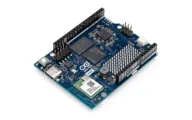
Models run on the CPU cores here, so the memory’s speed and how fast those cores can read it set the pace: small models (about 1-4B) are usable, bigger ones are slow. We plan around 2.8 GB of the 4.0 GB (what Linux leaves free for a model). No NPU for language models. Adreno 702 GPU, plus an STM32U585 microcontroller for real-time I/O.
More about this hardware
| Maker | Arduino |
|---|---|
| Type | Single-board computer or edge AI board |
| Share of memory for models | 70% (what Linux typically leaves free on a board this size) |
| Chip | Qualcomm Dragonwing QRB2210 |
| AI accelerator | No NPU for language models. Adreno 702 GPU, plus an STM32U585 microcontroller for real-time I/O. |
| Boards with this chip | Arduino UNO Q (2 GB / 4 GB) |
| Memory type | LPDDR4X, 2× 16-bit at 1804 MHz |
| Bandwidth figure | 14.4 GB/s, the chip’s rated memory speed |
| Note | 4× Cortex-A53 at 2.0 GHz running Debian. Tiny models only (estimate, at about 12% of the rated memory speed). |
| Specifications | docs.qualcomm.com |
Apps that run models well on the Arduino UNO Q (4 GB)
Linux on ARM boards
1 product with the Arduino UNO Q (4 GB)
Best LLMs for the Arduino UNO Q (4 GB)
| Quality | Model | Quant | Memory | Speed | Runs |
|---|---|---|---|---|---|
| 55Good quality (B) · 55 of 100: how capable the model is at Q6_K, whatever it runs on. Match score 67/100 (quality, fit, speed and memory use) sets the ranking. | LFM3 1.7B | Q6_K | 2.3 GB | 1.2 tok/s | Very slow |
| 57Good quality (B) · 57 of 100: how capable the model is at Q4_K_M, whatever it runs on. Match score 67/100 (quality, fit, speed and memory use) sets the ranking. | MiniCPM5 2B | Q4_K_M | 2.7 GB | 1.2 tok/s | Very slowtight fit |
| 48Fair quality (C) · 48 of 100: how capable the model is at Q5_K_M, whatever it runs on. Match score 64/100 (quality, fit, speed and memory use) sets the ranking. | LFM3-VL 2B | Q5_K_M | 2.3 GB | 1.3 tok/s | Very slow |
| 46Fair quality (C) · 46 of 100: how capable the model is at Q2_K, whatever it runs on. Match score 62/100 (quality, fit, speed and memory use) sets the ranking. | Spark-X2.6 4B | Q2_K | 2.8 GB | 1.2 tok/s | Very slowtight fit |
| 42Fair quality (C) · 42 of 100: how capable the model is at Q2_K, whatever it runs on. Match score 60/100 (quality, fit, speed and memory use) sets the ranking. | TMax 4B | Q2_K | 2.8 GB | 1.1 tok/s | Very slowtight fit |
| 41Fair quality (C) · 41 of 100: how capable the model is at Q4_K_M, whatever it runs on. Match score 60/100 (quality, fit, speed and memory use) sets the ranking. | LFM2.5 2.6B | Q4_K_M | 2.6 GB | 1.1 tok/s | Very slowtight fit |
| 38Basic quality (D) · 38 of 100: how capable the model is at Q5_K_M, whatever it runs on. Match score 60/100 (quality, fit, speed and memory use) sets the ranking. | TMax 2B | Q5_K_M | 2.3 GB | 1.3 tok/s | Very slow |
| 41Fair quality (C) · 41 of 100: how capable the model is at Q4_K_M, whatever it runs on. Match score 60/100 (quality, fit, speed and memory use) sets the ranking. | Jamba Reasoning 3B | Q4_K_M | 2.8 GB | 0.9 tok/s | Very slowtight fit |
| 39Basic quality (D) · 39 of 100: how capable the model is at Q4_K_M, whatever it runs on. Match score 59/100 (quality, fit, speed and memory use) sets the ranking. | PaddleOCR-VL 1.6 0.9B | Q4_K_M | 1.6 GB | 3.1 tok/s | Slow |
| 38Basic quality (D) · 38 of 100: how capable the model is at Q4_K_M, whatever it runs on. Match score 59/100 (quality, fit, speed and memory use) sets the ranking. | Qwen3.5 2B | Q4_K_M | 2.3 GB | 1.3 tok/s | Very slow |
| 30Basic quality (D) · 30 of 100: how capable the model is at Q2_K, whatever it runs on. Match score 59/100 (quality, fit, speed and memory use) sets the ranking. | Unlimited OCR 2 (3B-A0.6B) | Q2_K | 2.7 GB | 7.9 tok/s | Slowtight fit |
| 39Basic quality (D) · 39 of 100: how capable the model is at Q4_K_M, whatever it runs on. Match score 59/100 (quality, fit, speed and memory use) sets the ranking. | Jamba2 3B | Q4_K_M | 2.7 GB | 1.0 tok/s | Very slowtight fit |


Best Image models for the Arduino UNO Q (4 GB)
| Quality | Model | Quant | Memory | Speed | Runs |
|---|---|---|---|---|---|
| 28Basic quality (D) · 28 of 100: how capable the model is at FP16, whatever it runs on. Match score 54/100 (quality, fit, speed and memory use) sets the ranking. | SD Turbo | FP16 | 2.6 GB | 29 s | Runs welltight fit · encoder unloaded after use |
| 42Fair quality (C) · 42 of 100: how capable the model is at FP16, whatever it runs on. Match score 54/100 (quality, fit, speed and memory use) sets the ranking. | Realistic Vision V5.1 | FP16 | 2.5 GB | 7.2 min | Very slowtight fit · encoder unloaded after use |
| 40Fair quality (C) · 40 of 100: how capable the model is at FP16, whatever it runs on. Match score 53/100 (quality, fit, speed and memory use) sets the ranking. | DreamShaper 8 | FP16 | 2.5 GB | 7.2 min | Very slowtight fit · encoder unloaded after use |
| 30Basic quality (D) · 30 of 100: how capable the model is at FP16, whatever it runs on. Match score 51/100 (quality, fit, speed and memory use) sets the ranking. | LCM DreamShaper v7 | FP16 | 2.5 GB | 1.5 min | Slowtight fit · encoder unloaded after use |
| 50Fair quality (C) · 50 of 100: how capable the model is at FP16, whatever it runs on. Match score 51/100 (quality, fit, speed and memory use) sets the ranking. | PixArt-Σ XL 1024 | FP16 | 2.3 GB | 11.2 min | Very slowCPU offload |
| 35Basic quality (D) · 35 of 100: how capable the model is at FP16, whatever it runs on. Match score 51/100 (quality, fit, speed and memory use) sets the ranking. | Stable Diffusion 1.5 | FP16 | 2.5 GB | 7.2 min | Very slowtight fit · encoder unloaded after use |


Best Video models for the Arduino UNO Q (4 GB)
| Quality | Model | Quant | Memory | Speed | Runs |
|---|---|---|---|---|---|
| 35Basic quality (D) · 35 of 100: how capable the model is at FP16, whatever it runs on. Match score 42/100 (quality, fit, speed and memory use) sets the ranking. | AnimateDiff v3 (SD 1.5) | FP16 | 2.6 GB | 2.5 h | Very slowtight fit · CPU offload |

Best Decision models for the Arduino UNO Q (4 GB)
| Quality | Model | Quant | Memory | Speed | Runs |
|---|---|---|---|---|---|
| 86Excellent quality (A+) · 86 of 100: how capable the model is at Q8_0, whatever it runs on. Match score 79/100 (quality, fit, speed and memory use) sets the ranking. | Jina Reranker v3.5 | Q8_0 | 1.7 GB | 40.4 s | Very slow |
| 84Great quality (A) · 84 of 100: how capable the model is at Q8_0, whatever it runs on. Match score 78/100 (quality, fit, speed and memory use) sets the ranking. | Jina Reranker v3 | Q8_0 | 1.7 GB | 40.4 s | Very slow |
| 80Great quality (A) · 80 of 100: how capable the model is at Q8_0, whatever it runs on. Match score 77/100 (quality, fit, speed and memory use) sets the ranking. | GLiNER2.5 Decide | Q8_0 | 1.2 GB | 17.8 s | Very slow |
| 81Great quality (A) · 81 of 100: how capable the model is at Q6_K, whatever it runs on. Match score 76/100 (quality, fit, speed and memory use) sets the ranking. | mxbai-rerank-large v2 | Q6_K | 2.1 GB | 103.4 s | Very slow |
| 80Great quality (A) · 80 of 100: how capable the model is at Q8_0, whatever it runs on. Match score 76/100 (quality, fit, speed and memory use) sets the ranking. | FRIDA-Decisions | Q8_0 | 1.7 GB | 29.7 s | Very slow |
| 80Great quality (A) · 80 of 100: how capable the model is at Q8_0, whatever it runs on. Match score 76/100 (quality, fit, speed and memory use) sets the ranking. | Qwen3 Reranker 0.6B | Q8_0 | 1.7 GB | 40.4 s | Very slow |
| 78Great quality (A) · 78 of 100: how capable the model is at Q8_0, whatever it runs on. Match score 75/100 (quality, fit, speed and memory use) sets the ranking. | OpenAI Privacy Filter | Q8_0 | 2.4 GB | 1.8 s | Very slowtight fit |
| 77Great quality (A) · 77 of 100: how capable the model is at Q5_K_M, whatever it runs on. Match score 75/100 (quality, fit, speed and memory use) sets the ranking. | zerank-1 small | Q5_K_M | 2.3 GB | 115.4 s | Very slow |


Estimates come from published hardware specs and our open formulas, not from running the model on your machine. Real speed varies with runtime, drivers and settings. Numbers marked “Measured” come from a linked benchmark.